Here are some serious and not-so-serious things to read about science as you drink your eggnog this week.
Vaccines
“Vaccines work. Here are the facts” is an awesome cartoon by Maki Naro, refuting the antivaccine arguments and giving a great and accessible overview of why vaccination is important. This deserves to go viral, so please share it with your friends! And while you’re on the treadmill or walking your dog this week, take a listen to “The Most Important Playground Conversation”, a discussion hosted by Voices for Vaccines in which VM writer Colin discusses strategies for discussing vaccination science with other parents.
Science publishing
Retraction Watch just received a $400,000 grant from the MacArthur Foundation to develop a database of retracted papers. This database would mean that scientists could check that the literature they rely upon in writing grants and papers haven’t been retracted. And they’re hiring an editor and database developer! This is outstanding news for those of us concerned about improving the quality of scientific publications.
Women in Science
Women have played a meaningful, but largely unrecognized, role in the history of amateur radio. The Mary Sue has a great article honoring female ham radio operators, which I particularly enjoyed because I’m one of their number! To my fellow YLs, 33 from KF5ZMF!! To everyone else, check it out and consider studying for your ham license! It’s not incredibly difficult, and it’s tremendous fun.
Science literacy and skepticism
I really like “Ask for Evidence”, a guide to evaluating the legitimacy of scientific and medical claims. It’s a simple, straightforward and clear explanation, and a good potential teaching tool. Explore the site–there are a bunch of posts by specific topic as well! You might, for example, use these approaches when evaluating claims made by the “Food Babe” who recently revealed some serious shortcomings in her understanding of chemistry.
Research
Did you know that the human milk microbiome has been characterized? That the flora present within human milk differs between mothers who gave birth vaginally and by caesarian? This post gives a really great explanation of this fascinating research.
Sweet Science
Tommy Toehold is hands-down my favorite combat sports cartoon journalist. (If you’re an MMA fan, then you’re probably nodding your head right now). I’m mentioning him in this post because he recently did an awesome video about the women’s MMA show that my sister is the matchmaker for, “How Invicta Took Over The World”. I’m a bit biased, but the latest Invicta show in Houston last week was pretty incredible, and he really gives a great introduction to the show. However, I still think that Tommy’s funniest video of all time is this one of Joe Rogan and Mike Goldberg commentating on the EA UFC game’s glitches. (Warning: language in these videos is safe for neither work nor children.)
Finally, just a reminder that if you want daily links to science stories I find interesting (some of which I included above), “like” the VM page on Facebook!
I usually don’t respond to many comments on my blog, preferring instead to encourage conversation between readers. I also don’t typically close comments on any of my pieces, so conversations and reactions continue for a long time. Sometimes that takes the discussion in an interesting direction. I think that a few recent comments on my “Dear parents…” piece are worth highlighting, as they provide an excellent window into an ongoing discussion of a very common anti-vaccine argument. Continue reading →
A professor I know was recently sent a manuscript to review from PLOS ONE. Nothing unusual in that…except that it was his own paper. After briefly debating how to respond, he accepted the invitation to review the paper, and submitted the following review:
We Americans sometimes seem to have only two settings when it comes to public health issues; “unconcern” and “panic”. (I think the media deserve a great deal of blame for this, but that’s another blog post). The last few weeks have seen the switch flipped to near panic about Ebola, after the recent infection of two Texas Health Presbyterian nurses who were treating infected patient Thomas Eric Duncan, and possible exposure of additional people after one of the nurses took a commercial flight. The fact that forty three individuals who had direct contact with Mr. Duncan have now passed the 21 day incubation period for the disease without signs of infection, that Senegal has been declared free from Ebola (no new infections have occurred there for 42 days), that Nigeria is close to the same milestone, and that the two nurses who treated Mr. Duncan, Amber Vinson and Nina Pham, are doing much better, don’t seem to make much of a dent in the fearmongering I’ve seen in recent weeks.
And now with the report that a physician with Doctors Without Borders, who recently returned to his home in New York City from West Africa, has tested positive without Ebola, the “Ebola panic” is just going to get worse.
So given the fact that I live so close to the “Ebola hospital” (just two hours!) I thought I’d share with my readers what precautions I’m taking to protect my family’s health. Continue reading →
I haven’t written here about the CDC “whistleblower” issue, because I was in Shanghai when the story broke with both limited internet access and limited desire to take time away from adventures to write. Orac did an excellent job of staying on top of the story, and I refer the interested reader to his series of posts on the subject, as well as this excellent summary by Todd W. at Harpocrates Speaks, and this one by Retraction Watch.
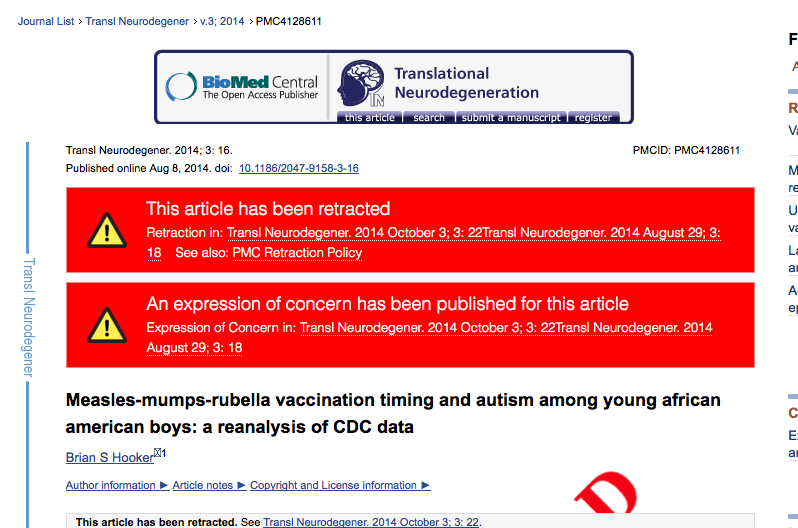
However, as many people who read Violent Metaphors have a specific interest in vaccine/anti-vaccine issues, I thought it would be worth talking about the most recent development in the story; specifically, the retraction of Brian Hooker’s journal article purporting to show an increased risk of autism among African American boys who receive the MMR vaccine.
You may have seen the news about a Texas court throwing out Andrew Wakefield‘s lawsuit against Brian Deer, the investigative journalist who did so much to uncover Wakefield’s fraudulentanti-vaccine study. You can read the court’s opinion for yourself, but I’ve already seen some inaccurate commentary on it. Here’s a little background on the case, and a quick explanation of what happened last week for non-lawyers.
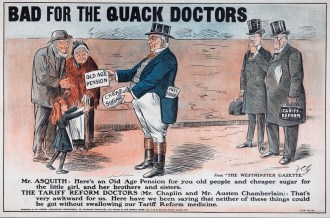
Apparently this is “Asquith as John Bull giving cheap sugar and an old age pension to a child and an elderly couple.” I have no idea what it means. But I dig old editorial cartoons (and the headline).
I’m putting the finishing touches on a longer article to share later this week, but in the meantime, here are some stories that I’ve found interesting over the last week: Continue reading →
Happy Wednesday! I’ve been home for a few days, getting over jet lag and back into the routine of the semester. I’ll probably do a longer post about China when I have time to download all the photos from the camera. In the meantime here’s a shot of the Bund in Shanghai:
While in China, I accumulated a huge backlog of articles to read, and as I go through them I decided I’d share a few of them with you (I’m thinking of making it a regular feature here). Continue reading →
I’ve been waiting for this paper for months! The Willerslev group has just published the results of their study on ancient DNA from Paleo-Eskimos in the North American Arctic. Unfortunately, this article is behind a paywall at the journal Science, but I’ll give you a brief summary of the results, and talk a bit about why this paper matters and what it means for our understanding of the peopling of the Americas. Continue reading →
In a series of recent posts I and several others have strongly criticized Nicholas Wade’s recent book “A Troublesome History”, which purports to show that human races are biologically meaningful categories, characterized by different behavioral tendencies (which have resulted in different degrees of socio-political success). Now 139 professors with expertise in genetics, human biology, biological anthropology, and evolution have added their voices to this discussion, criticizing Wade’s book in a strongly worded letter that appears in the New York Times today. The full text of their letter can be found here. Organized by Grahm Coop, Michael Eisen, Rasmus Nielsen, Molly Przeworski, and Noah Rosenberg, the signatories include many of the leading researchers in human genomics (a full list of signatories and their affiliations can be found here).
Several of the authors are people whose research Mr. Wade cited approvingly in his book as supporting his thesis, such as Dr. Sarah Tishkoff, Dr. David Reich, and Dr. Noah Rosenberg (lead author of the 2002 paper that Mr. Wade uses as the primary evidence for his conception of genetically distinct races).
According to Michael Balter in an article appearing today in Science:
The letter was spearheaded by five population geneticists who had informally discussed the book at conferences, says co-organizer Rasmus Nielsen of the University of California, Berkeley. “There was a feeling that our research had been hijacked by Wade to promote his ideological agenda,” Nielsen says. “The outrage … was palpable.”
The authors don’t mince words:
Wade juxtaposes an incomplete and inaccurate account of our research on human genetic differences with speculation that recent natural selection has led to worldwide differences in I.Q. test results, political institutions and economic development. We reject Wade’s implication that our findings substantiate his guesswork. They do not.
We are in full agreement that there is no support from the field of population genetics for Wade’s conjectures.
This letter is highly inconvenient for Mr. Wade, making it clear that the senior researchers in the fields from which he’s trying to marshal support categorically reject his storytelling and bad science. Nor can he continue to make the (untrue) argument that critiques of his book are largely politically based, and conducted mainly by social scientists. A strong blow has been dealt to scientific racism today.
UPDATE: Mr. Wade has issued a statement responding to the letter. He starts out reasserting the position I claimed above that he can’t continue to hold:
“This letter is driven by politics, not science. I am confident that most of the signatories have not read my book and are responding to a slanted summary devised by the organizers.
As no reader of the letter could possibly guess, “A Troublesome Inheritance” argues that opposition to racism should be based on principle, not on the anti-evolutionary myth that there is no biological basis to race. Unfortunately many social scientists have long denied that there is a biological basis to race. This creed, prominent throughout the academic world, increasingly impedes research. Biologists risk damaging their careers if they write explicitly about race.
In yesterday’s post on the subject, Mr. David Dobbs described who several of the authors are:
Those signers include
Noah Rosenberg, the lead author of a 2002 paper that Wade leans on especially heavily, ”Genetic Structure of Human Populations,“ as well as at least two other authors of the paper.
Yale’s Kenneth Kidd, who is one of the world’s most respected population geneticists, a central figure in establishing the field, and another co-author on the 2002 Rosenberg paper.
Stanford’s Jonathan Pritchard, another co-author on that paper and the researcher whose lab designed the ”Structure“ genetic analysis software that created the ”clustering“ data Wade says supports his argument.
Jun Li and Richard Myers, the lead and senior authors of a 2008 paper, ”Worldwide Human Relationships Inferred from Genome-Wide Patterns of Variation,” that, as I noted in my review, Wade misrepresented as supporting his argument.
These and the other signatories of the letter are the leaders in the field of human population genetics. They do not shy away from research and writing about human genetic variation. Mr. Wade is wrong to imply that they are being intimidated by cultural anthropologists. The fact that they agree on a single statement (on anything) is extraordinary and should be treated seriously.
Further, I suspect that more people on that list have read his book than he believes, simply because I’ve talked to them. In fact, Jerry Coyne, one of the signers of the letter has read it twice. (I encourage you to read his thoughts on the subject at the link above).
Disturbingly, Mr. Wade appears to be adopting the methodology of his “HBD” followers in claiming that evolution requires acceptance of his view of race. The data do not support that position, and saying so doesn’t make any of us anti-evolution, no matter how loudly he says it.
He goes on:
These attacks have included repeated assertions that the book is scientifically inaccurate, a charge for which I have seen no basis. In the same vein, this letter issues general charges without supporting evidence.
You might find this American Anthropological Association-sponsored debate between Agustin Fuentes and Nicholas Wade illuminating:
ETA (8/10/14): I mistakenly listed only Dr. Coop as the organizer of the letter. I’ve edited to add the names of the other professors who organized and wrote it. My sincere apologies for the oversight.




 Violent metaphors
