Deep (Conspira)Sea Fishing: A Fundraising Drive

A large, diverse conference of people with very unusual beliefs is coming up. I want to attend as research for my book and blog posts on Violent Metaphors. Tickets are expensive, so we’re trying to keep costs down with a little crowdfunding. Please visit http://www.gofundme.com/ss29jrfk to donate if you can. If you can’t donate, just sharing the link is incredibly helpful. Pitch in, and let’s lay the groundwork for a deep discussion of far-out ideas next year! The following post is our original crowdfunding appeal.

Do you believe in acupuncture, alien abductions, ancient aliens, chi, crop circles, entity possession, “forbidden archaeology” or “forbidden religion,” homeopathy, near-death experiences, occult Nazi super-weapons, Planet X, poisoned vaccines, spiritual channeling, the new world order, or illegal immigrants from Zeta Reticuli? Do you go to bed worrying about the New World Order, the Vatican, the FBI, the CIA, the NSA, NASA, the WHO, the CDC, the UN, space aliens and/or demons conspiring against you and all right-thinking people? And are you convinced that the world is ruled from the Bohemian Grove, a secret bunker under the Denver airport, Bilderberg meetings, the Council on Foreign Relations, Buckingham Palace, alien worlds or other dimensions?

Probably not, or at least probably not all of it. But thousands of people do believe those things, and other things stranger than you can imagine. This January, dozens of experts these fields will gather together on a cruise ship called the Ruby Princess. It’s called, honestly and cleverly enough, the Conspira-Sea Cruise. They’ll spend seven days explaining, discussing, and even demonstrating their beliefs. Some of them are fairly famous, like Andy Wakefield and Sherri Tenpenny, who will be sharing their theories on vaccines. Others are relatively obscure, like Laura Magdalene Eisenhower, great-granddaughter of the former president, who claims to have been recruited for a secret Mars colonization effort and that stargates began opening around the Earth in 2012. For a full week, conspiracy theorists, dreamers, and snake-oil salesmen of every stripe will be preaching and peddling their wares.

Cruise0
I want to be there. You can help make that happen by visiting our Go Fund Me sitehttp://www.gofundme.com/ss29jrfk. We’re nearly halfway there!

Continue reading

Open access and pseudoarchaeology: an encouraging update!

7752980066_a73cbbb6aa_k

Back in July I wrote about a new collection of reviews of pseudoarchaeology books by archaeologists that appeared in the journal American Antiquity. I was delighted about this effort by the authors and editors–I think we need more of this sort of direct engagement–but very disappointed that the reviews were inaccessible to the majority of interested, non-academic readers. I and others called on the SAA to make this collection free for public access.

As it happens, a few weeks ago they did just that! You are now able to access the reviews through this link. (I would have written about this much sooner, but I’ve been swamped with work in my new position). In addition, I want to call your attention to the great perspective piece that Kristina Kilgrove wrote for Forbes, in which she nicely summarized the problem archaeologists have with the pseudoscientific approach to archaeology:

Archaeologists are trained as anthropologists to recognize and celebrate the diversity of humanity, both today and in the past. Eric Cline succinctly explains this in his review, noting “pseudoarchaeologists cannot accept the fact that the mere humans might have come up with great innovations such as the domestication of plants and animals or built great architectural masterpieces such as the Sphinx all on their own; rather, they frequently seek or invoke divine, or even alien, assistance to explain how these came to be.”

Kudos to the SAA for making this resource available to everyone, and many thanks to the archaeologists who took the time to write these excellent reviews, with particular credit to Don Holly for organizing them! I hope that more archaeologists and biological anthropologists will follow this example. (In this spirit, I’ve just submitted the final draft of a paper on mitochondrial haplogroup X that addresses many of the common misconceptions about it–see comments on this piece for examples– to an academic journal. I’ll update you guys when it comes out).

Mixed messages during National Immunization Awareness Month

Be a vaccine superhero this month !

I haven’t had the chance to write much here about vaccines recently, so I was delighted to participate in MHA@GW’s initiative to highlight vaccination for National Immunization Awareness Month with a series of posts from guest bloggers entitled “Why Immunize?” My post focused on science literacy, and how to communicate with others about this issue:

In all likelihood, parents have already made up their mind as to whether or not they’ll vaccinate themselves and their children. And in all likelihood, that decision was to vaccinate.

These parents are motivated by a shared concern for their children and community. They know that vaccines prevent many childhood diseases, and that by maintaining high vaccination rates in their community, they maintain herd immunity. Perhaps they’ve seen the comparison External link of morbidity rates in the pre- and post-vaccine era and understand the significant impact vaccines have made in preventing the worst childhood diseases. They may have been worried about the outbreak of measles among families who took their children to Disneyland earlier this year, which hit unvaccinated people the hardest External link. Regardless of how they came to this decision, the vast majority of parents understand External link that the risks of vaccines are low relative to their tremendous benefits.

This is good news for the health of our communities. It’s critical that we continue to talk about immunization, because vaccine opponents are relentless — see the comments on my piece External link here for many examples of the bad science and provocative rhetoric they employ.

Speaking up is the most important step, letting parents know that their decision to vaccinate is the safest and most common way people protect their children. The anti-vaccine minority is disproportionately loud, partly because vaccines are so safe, effective and ubiquitous that they become part of the background landscape of parenting. Fortunately, in reaction to harmful pseudoscientific scaremongering and events like the Disneyland outbreak, people are motivated to speak out in favor of vaccines.

You can read the rest of my post here.

But I was dismayed to see that just hours after my piece was posted, a mainstream news site posted an article purporting to give balanced coverage on “the vaccine debate”, but instead propagated the same old mistruths and pseudoscience that have been thoroughly debunked by the scientific community again and again. This article, which features comments from a “Montana mother” given the same weight as those from a trained physician, and concludes by telling parents how to get vaccine exemptions for their children before school starts, is utterly reprehensible journalism. It’s a depressing reminder that we can’t ever let up on our efforts to educate journalists, as well as the general public, on basic scientific and medical issues

So in honor of National Immunization Awareness Month, I’m asking all of you to make a small but meaningful contribution to this effort. Please share at least one example of good news coverage on vaccines with your online and in-person friends. Your voice makes a difference in this conversation.

h/t Tara Haelle for the link to the news article.

Good science communication means never calling them “retard” – even if you’re Nassim Taleb

Communicating science to people who aren’t scientists is very hard to do well. Nassim Taleb should be very good at it, based on his enormous book sales and even more enormous opinion of his own skills. But we all have our demons, and Taleb has succumbed to his. Rather than encouraging a healthy discussion about science, he’s picked a side and declared all-out war on the people who disagree with him. Taleb even admits that his strategy is to prevent conversations from happening by abusing and insulting people who question him, and encouraging his followers to join in. What’s the point of that strategy? It doesn’t help communicate science, resolve legitimate questions about the facts, or even address the supposedly evil motives of his critics. All it really does is feel good. Nassim Taleb has chosen self-gratification over real engagement. Let’s talk about why that’s unproductive and unethical.

Anger Controls Him by Jessica Flavin

Continue reading

Public outreach that’s inaccessible to the public.

Inaccessibility
Inaccessibility

Edit 9/3/15: The SAA has opened up this collection for public access! See my post on it here. 

I was delighted to read at Jason Colavito’s excellent blog that the journal American Antiquity has just published a special section in its current issue that’s devoted to debunking popular pseudo-archaeological ideas.   This is a fantastic example of the kind of outreach that I (and many others) would like to see academics and academic institutions engage in.  I want to commend American Antiquity (and its parent organization, the Society for American Archaeology) for this.  But with a caveat: outreach actually needs to, well, reach its intended audience. Right now, that’s not the case.  Continue reading

Encouraging science journalism: The genome of Kennewick Man.

A little over a year ago the complete genome sequence of a Clovis individual, the 12,500 Anzick child, was published. His sequence gave us a fascinating glimpse of ancient Native American genetic diversity, and new insights into the early peopling of the Americas. At the time, however,  I was unhappy about how the media covered it:

“Unfortunately, several press reports chose to find controversy in a decidedly non-controversial story by giving undue weight to problematic “alternative” explanations of Native American origins, including the Solutrean hypothesis, and other “European contributions” to Native American ancestry.”

Last week saw the announcement (also from Eske Willerslev’s lab group: they’re amazingly prolific) of the sequencing of yet another significant ancient American genome: the 8,500 year old skeleton from Washington popularly called “Kennewick Man.”  This time the press did an exemplary job of covering the news.

Continue reading

No, Seriously, Don’t Politicize Anti-Vax Sentiment

It’s Wrong and It’s Dangerous

I read Amanda Marcotte’s recent piece, Vaccination becomes a more partisan issue, with Republicans on the wrong side of it, despairingly. The only thing worse than someone trying to politicize ani-vaccine sentiment is someone doing it with a giant megaphone. With all due respect to the author, her piece has two giant flaws. First, its basic premise is wrong: anti-vax ideology is demonstrably not very well connected to basic left-right ideology or party affiliation. Second, her article is ironically more likely to be harmful than a dozen frothing anti-vax pieces.

Continue reading

A normal person’s review of the Apple Watch

I’ve had the Apple Watch for a few weeks now, and enough people have asked me about what I think of it that I thought it was worth writing a post. Since the majority of reviews I’ve seen are all from tech or fashion people, and I don’t find these particularly helpful, I thought I’d give a bit of a different perspective– one from a completely normal person who just happens to have gotten one early. I have the Sport version with the 38mm case, and the white band.

Let’s be real: I wouldn’t have bought this watch for myself. Despite the fabulous sums of shill money that certain antivaxxers are convinced I’m pulling in, I actually don’t have a spare $350 lying around. (If for some reason you’re burning with curiosity about what I make, go look up NSF biology postdoc salaries for a ballpark figure). The watch was an early wedding gift from my fiancé, who is both in love with being an early adapter of new tech but a staunch enemy of all things Apple. Yeah, I don’t get it either.

But that being said, I absolutely love my watch.  I’ve never worn one regularly before, but three weeks of wearing this one has made me an addict. Here are the ways in which I use it, and the ways in which I don’t.  Continue reading

The Most Important Playground Conversation, A Presentation

Earlier this year, the California Immunization Coalition invited me to speak at their 2015 summit. They’d heard me on a conference call with Voices for Vaccines, discussing methods for helping parents make the best decisions about immunization. I was delighted to have the chance to work with the Coalition, which does exemplary work in protecting children from vaccine-preventable diseases.

Thanks to Jennifer and Violent Metaphors, I have a chance to share the same material I presented at the Summit with you. My speech wasn’t recorded, which is a shame because I’m sure it was a treat and delight for everyone in the audience. (Self-deprecating humor is a common persuasive tool. As is handsomeness.) Instead I’m putting up each of the slides with a brief explanation of what I discussed, where it isn’t obvious from the image.

Continue reading

The Genetic Analysis of the Alaskan North Slope

My colleagues and I have just published a paper on the genetic diversity and population history of contemporary Iñupiat peoples (the indigenous inhabitants of the North Slope of Alaska) in the American Journal of Physical Anthropology.  It’s open-access for at least a few months, so you can read it in its entirety here, our collaborator Dr. Anne Jensen ‘s thoughts on it here, and Archaeology Magazine’s article on the paper here. I’ve also summarized our findings below.

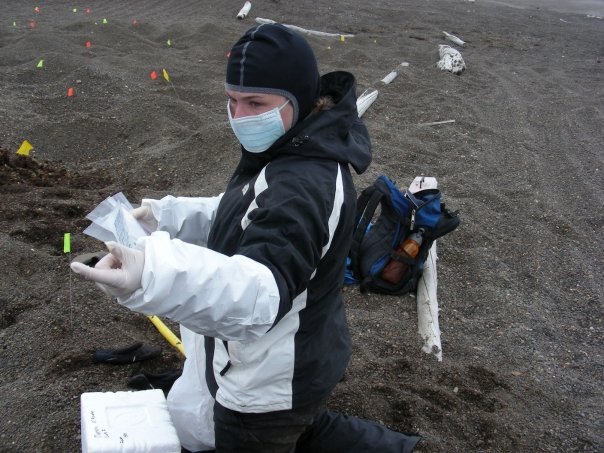
Here I am working at the Nuvuk site in 2009.
Me, working at the Nuvuk site in 2009.

Continue reading