Soyuz, carrying three members of Expedition 36 (Fyodor Yurchikhin, Karen Nyberg, and Luca Parmitano) has just docked with the International Space Station a few minutes ago (9:10 pm Central Time).
Congratulations to all the scientists and engineers who make this happen. Good luck on your mission!
—————————————————–
*from a previous docking, as recorded by Chris Hadfield
Edited to add:
Here is the quote by Theodore Roosevelt that the title references:
It is not the critic who counts; nor the one who points out how the strong person stumbled, or where the doer of a deed could have done better.
The credit belongs to the person who is actually in the arena; whose face is marred by dust and sweat and blood, who strives valiantly; who errs and comes short again and again, because there is no effort without error and shortcoming; who does actually strive to do deeds; who knows the great enthusiasms, the great devotion, spends oneself in a worthy cause; who at the best knows in the end the triumph of high achievement; and who at worst, if he or she fails, at least fails while daring greatly.
Far better it is to dare mighty things, to win glorious triumphs even though checkered by failure, than to rank with those timid spirits who neither enjoy nor suffer much because they live in the gray twilight that knows neither victory nor defeat.
I know it’s technically no longer the weekend, but since it’s a holiday here in the United States, I’m going to ignore that fact. Here are some things I found interesting this past week:
Something I read: “Going Clear: Scientology, Hollywood, and the Prison of Belief” by Lawrence Wright. I’ve been reading this a chapter at a time on the El while commuting to my lab, and I’ve finally finished it. It’s an absolutely fascinating glimpse into the inner workings of Scientology, coupled with a history of L. Ron Hubbard and how he came to found the organization.
Coincidentally, a few weeks ago on a date** I actually went to a Scientology-sponsored “Citizen’s Commission on Human Rights” traveling exhibit in Bucktown called “Psychiatry: An Industry of Death”. Essentially, the exhibit consists of a series of movies (which were boring and I skipped), and posters with super scary images:
with explanations in text about how psychiatry is a global conspiracy with a mission to generate profits and control the world by making up diseases and using torture treatments to subjugate people. Evidently psychiatry is the true cause of all the past evil in the world, responsible for the Holocaust, torture, apartheid, scientific racism, Russian gulags, and Hemingway’s death.
The exhibits were utterly fascinating, and all entirely wrong. I’m not going to go into a detailed refutation of their inaccurate claims here (although I could do that in another post if anyone’s interested). But I do want to encourage people to read a bit about the history and philosophy of Scientology, because efforts like these do have consequences. Not only do they misrepresent a medical profession and ongoing scientific research associated with it, they also further stigmatize mental illness and potentially increase the reluctance of people afflicted with such illnesses to seek treatment for themselves. While there are certainly worthy and interesting discussions to be had about the use of psychiatric medication, I urge you to educate yourselves and recognize the difference between legitimate critiques and blatant manipulation.
On a (much) lighter note…
Here are some things I found interesting on the web:
–This wind map of the United States is completely hypnotic . Definitely recommend staring at this for a while if you get stressed. Our planet is astonishing.
—A blog post about how my sister, Julie Kedzie, poses a significant challenge to current UFC champion, Ronda Rousey. Obviously I agree!
–And finally, this stunning color film of London in 1927 gave me chills. I love glimpses into the past like this.
Do you notice how slowly vehicles moved? Life was at a different pace back then.
What do you think about Scientology? Am I now a Suppressive Person for speaking out about it? What did you like best about the London film? Do you have any book recommendations for me? I’d love to hear your thoughts in the comments below. And have a lovely and adventurous week, everyone!
For Americans, today is Memorial Day, a holiday to honor soldiers killed in wars. If you’re looking for a way to make a charitable gesture in this spirit, consider donating to the Wounded Warrior project to help injured veterans find financial assistance and employment opportunities.
From my visit to the Very Large Array at the National Radio Astronomy Observatory (http://www.vla.nrao.edu/) last year. One of the most amazing places I’ve ever been.
I was reading an insipid article this morning, and became curious as to how many people actually find astrology meaningful. The easiest metric at 7 am on a Saturday morning is (naturally) Twitter, so I checked out the account of an astrology author, Terry Nazon: 73,266 followers.
Ms. Nazon seems to be trying to emphasize the importance of astrology in our culture through the most recent tweet of hers:
“There are about 10,000 professional astrologers in America & only 3,000 professional astronomers”
I don’t know if that’s true or not (Ms. Nazon didn’t cite her source, so I’m skeptical), but her popularity and that of astrology in general is something that ought to make me depressed. But it doesn’t at all, and I’ll explain why at the end of the post. Continue reading →
I love bats. I spent a huge amount of my childhood underground, exploring the caverns of the Ozark Highlands with my father and learned to respect bats and their importance in the ecosystem at a very young age. When I was in graduate school, I began doing bat rescue/rehabilitation in southern Indiana. Through my rescue work I came to appreciate the amazing diversity of personalities, behavioral traits, and intelligence levels between bat species. I also, unfortunately, had to confront a great deal of ugliness and ignorance among people towards bats. In future posts, I’m going to do my best to dispel some of the myths about bats, and introduce you to how cool they are. But for now, here is the best place to learn some basic facts about bats.
Are you afraid of bats? You don’t need to fear them any more than any other wild animal. Just be mindful that a bat on the ground may be sick. Never handle a bat with your bare hands: they are likely to bite you like any other stressed animal (and you do not want to be exposed to rabies). Bats are just as anxious as you are to avoid contact: they’re not out to attack you. Just leave them alone. If you have one in your house or find an injured one, please call a rescue person instead of harming it. Here are some bat rescue resources, or you can contact me and I’ll try to put you in touch with people who can help.
Bats are closely related to primates (us), and are extremely important parts of the ecosystem. So please, let’s be good friends to these wonderful creatures!
This is the first bat I ever rescued; a big brown bat (Eptesicus fuscus). Notice how I’m handling it without gloves? DON’T DO THAT. (The only reason I wasn’t wearing gloves with him was because I’m up to date on my rabies vaccinations, and I knew for a fact that this little guy wasn’t sick since I’d been caring for him for a while)
In 1941, an archaeologist named Glenn Black excavated a site called Angel Mounds just east of Evansville Indiana. Angel Mounds (AD1050-1400) belonged to the Mississippian culture, which was found throughout the Midwest and Southeast in the centuries just prior to European contact.
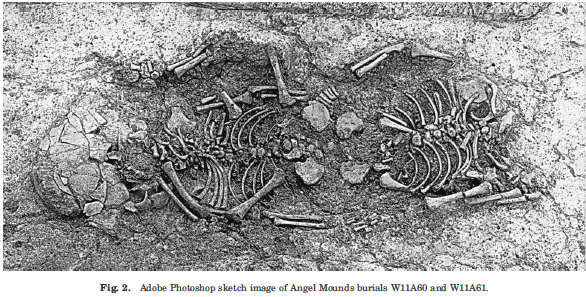
When excavating a region of the site dense in children’s graves, Black uncovered a grave which contained two babies buried together in a very unusual manner: heads facing away from each other, legs intertwined, hands joined: From Marshall et al. 2011, figure 2, showing the burial position of the two children. Note that this is not a photograph but rather a sketch image. While it’s important to show the disposition of the skeletal elements in order to illustrate the scientific background, out of respect for descendent communities I (and others) feel it is inappropriate to post actual photographs of human remains without permission.
He interpreted this burial as “flesh-joined” twins, as they didn’t have any fused skeletal elements. Conjoined twinning* occurs when a single fertilized egg splits only partially into two fetuses (as opposed to complete splitting in monozygotic twins). The rate of conjoined twinning in the United States is approximately 1/ 33,000-165,000 births, but the frequency of conjoined twinning in ancient societies is unknown.
The children’s remains, along with those of other people excavated from Angel, were taken to be cared for by the Glenn A. Black Laboratory of Archaeology at Indiana University, Bloomington.
Seventy years later, my colleague Dr. Charla Marshall became interested in the children, and in Black’s hypothesis that they were conjoined twins. With permission of the curators at the Glenn Black laboratory, she undertook a comprehensive analysis of the children.**
Dr. Charla Marshall, doing ancient DNA work. Note the protective clothing designed to minimize risk of contamination from modern DNA.
She and her colleagues found that the two children (designated W11A60 and W11A61) were approximately 3 months old, and had evidence for poor health, but otherwise saw no skeletal evidence that could either support or reject the hypothesis that they were conjoined twins.
Fortunately, Dr. Marshall happened to be an expert in the one method that would definitively tell whether the children were twins or not: ancient DNA analysis. Because mitochondrial DNA is maternally inherited, siblings (and twins) MUST have the same mitochondrial sequence.
Both children, despite having been dead for nearly a thousand years, had ancient DNA still preserved. By extracting the DNA and sequencing it, Dr. Marshall was able to determine their mitochondrial lineages (haplogroups). [I give a little bit of background into how ancient DNA research is done here and here].
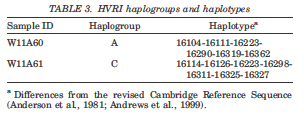
Surprisingly, they were different! In the table below, you can see the mutated DNA base positions for each child listed in the third column (under ‘haplotype’). The particular combination of mutations for each child means that they belonged to two different haplogroups: A and C.
Marshall et al. 2011, Table 3.
Therefore, the “conjoined twins” were neither twins nor siblings, nor maternal relatives of any kind. Black’s 70 year old hypothesis was wrong.
Why were they buried in such a peculiar way? Dr. Marshall and her colleagues (Cook et al., 2012)*** presented a paper last year at the Midwest Archaeological Conference in which they discussed possible interpretations for this burial practice.
Perhaps, they suggest, the children were non-maternal relatives (maybe half-siblings who shared a father?), who died at the same time and were buried together to reflect this close relationship. Or perhaps the arrangement of the babies’ bodies was entirely symbolic.
Twins play a special role in Eastern Native American iconography, and different Native American societies treat twins in different ways; in some cases they are regarded as having special spiritual power, in other ancient societies they were thought to be negative. Perhaps the co-burial of two maternally un-related children of the same age was meant to be symbolic of twinship, rather than having a literal meaning.
In general, co-burial of individuals was a pretty common practice among the ancient Mississippians, and typically archaeologists have interpreted the co-buried individuals as being related to each other. However, those of us doing ancient DNA research in the Midwest have been testing this hypothesis on co-burials and finding that they’re almost never maternally related. Because no ancient Y-chromosome DNA has yet been recovered from Midwestern co-burials, we don’t know if they might be paternally related.
The motivation for Mississippians to bury people together, and these two children at Angel Mounds in particular, continues to be a mystery. However, the approach of Dr. Marshall and colleagues is a very good example of how persistent research can disprove a long-standing, wrong hypothesis. It may be that future generations of students will be able to solve this mystery with additional genetic evidence.
———————————
*The more popular term, “Siamese twins”, was introduced by P.T. Barnum to refer to Eng and Chang Bunker (http://en.wikipedia.org/wiki/Chang_and_Eng_Bunker), who were members of his circus. “Siamese twins” has therefore taken on negative connotations associated with this history.
**Marshall C, Tench PA, Cook, DC, Kaestle FA. 2011. Conjoined twins at Angel Mounds? An ancient DNA perspective. American Journal of Physical Anthropology 146: 138-142.
***Della Collins Cook (Indiana U), Charla Marshall (Southern
Illinois U Carbondale), Cheryl Ann Munson (Indiana U), and Frederika A Kaestle (Indiana U). 2012. If Angel Twins Aren’t Twins, What DO They Represent? Paper presented at Midwestern Archaeological Conference, East Lansing Michigan, Oct 17-21, 2012
( http://www.midwestarchaeology.org/storage/MAC%20Program-final.pdf)
It’s been an adventurous week. Here is a random collection of things I found interesting:
What I found: I am a Game of Thrones addict (who isn’t at this point?). But I have to admit the accents drive me crazy. Apparently, I’m not the only one. This is a pretty cool discussion on the accents in the show…I suggest you check it out before the AWESOMENESS that will be happening tonight. (Have you read the books? No? What are you waiting for?)
What inspired me: Jacare’s UFC debut against Camozzi was a thing of beauty. Seriously.
What I read:
I always have good intentions to read as widely as possible, but I still have a tendency to read the same types of books over and over again. This week, however, a friend gave me a copy of something completely different: “Cool jobs in the music business!” by Jeffrey Rabhan. I know absolutely nothing about the music industry, but I started reading this while waiting for my much-delayed flight home to Chicago from New York on Wednesday, and finished it before my plane arrived. Now I know a bit more. If you have any interest whatsoever in a music career (or even if, like me, you don’t but just want to learn something completely new), I highly recommend it. For me, it was especially helpful because the very next day I went to a dear friend’s concert. With a little more background from having read this book, I made a nuisance of myself asking as many people as I could about their jobs (the sound technician, the tour manager, the drum tech, the security guys, the caterers, the guy who drove the bus), and I understood a little bit more of how everyone’s collective efforts produced a memorable night of music for thousands of people. Which brings me to my next thing…
What I listened to:
I’ve been friends with Andy Hurley for a couple of years (we are both students of Gym Jones). So when Fall Out Boy came to Chicago this past Thursday for a show at the Riviera, I was lucky enough to get to go. I love “Save Rock and Roll” , and it was an amazing experience to hear them play songs from it live, although I have to admit I chose my location more for the view than for the acoustics. If you get the chance to go see them, I really encourage you to! It’s a terrific show, and they are the nicest group of guys you’ll ever meet. Here are a few photos from the day:
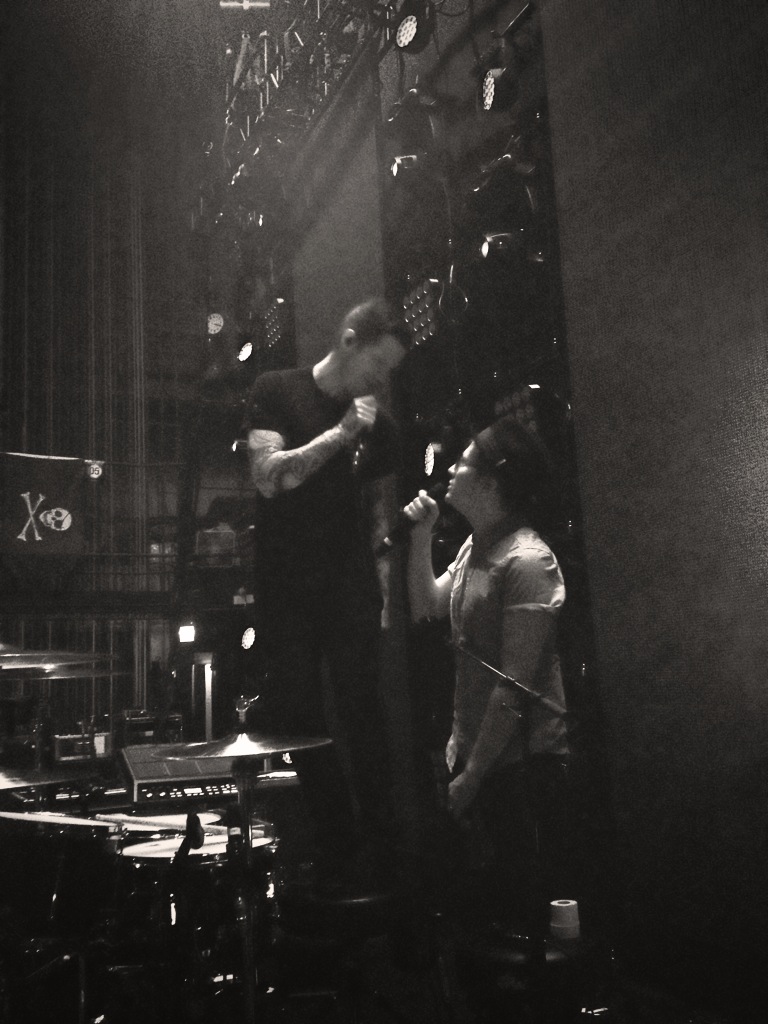
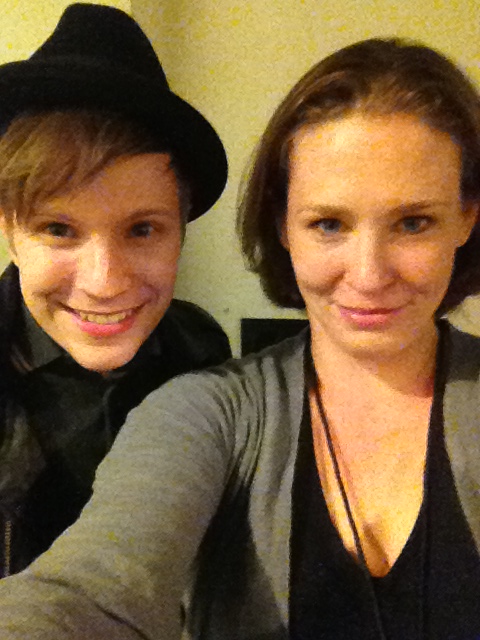
So many happy people!During soundcheck, Andy and Patrick sang “Save Rock and Roll” to each other. It was just as sweet as you might imagine.I’m really bad at taking pictures of myself, and since we had a lot of downtime before the show, Patrick tried to give me a tutorial on how to look cute.
Enjoy your Sunday! I’m off to the lake for a nice long walk.
Science is a systematic method of acquiring information. It depends on the idea that the natural world works according to certain principles, and that we can discover those principles through observation and experimentation. Science isn’t the the only way of knowing about the world, but we give it special respect because it works so well. (I talked more about that in my previous post).
Sometimes unscientific belief systems masquerade as science in order to claim the benefit of that special respect. In many cases (magic, ghosts, the Loch Ness monster), it’s fairly easy to tell them apart. But what about homeopathy? Intelligent design? Energy healing? Schools don’t do a very good job teaching students to recognize and understand good scientific research. Fortunately it’s really not that difficult, but it DOES take one or two more steps beyond just accepting what you read. Continue reading →
“If it disagrees with experiment it’s wrong.
In that simple statement is the key to science. It doesn’t make a difference how beautiful your guess is. It doesn’t matter how smart you are, who made the guess, or what his name is;
If it disagrees with experiment, it’s wrong”
–Richard Feyman
Here’s what it’s like to be a scientist:
You fall in love with a subject. You immerse yourself in your chosen subject, spending a few years reading all of the research that has ever been done in it. You go to conferences where you hear about what other people in your field have been doing, and you talk to them about what you’re doing. You share ideas.
You begin to observe some patterns, develop some ideas of your own about how your subject works. Questions about your subject that have never been answered occur to you. You think hard about whether they’re good questions, and ask advice from more experienced people in your field. You come up with testable ideas (called hypotheses), figure out experiments to test them, and what kind of data you need to in order to prove if they’re wrong.
Then you do the experiments. You think hard about the results you get. You repeat the experiments if you can. You do other experiments to see if you can disprove the results from the first experiments. You take your work to a conference and see what other experts think about it. Based on their feedback, you decide to publish your results and how you interpret them. You write up the whole process: questions, hypotheses, experimental design, results, and your interpretations of the results. You send it to a journal in your field.
The journal editor decides whether the paper is appropriate for the journal, and then contacts experts who specialize in the same field. These experts anonymously review the paper, decide whether the study is well designed, the results are valid, and the interpretation of the results is reasonable. If they decide that it’s acceptable, the paper is published. If not, the paper is rejected.
If your paper is published, your data are available to the rest of the scientific community. They may do the same experiments as you did, trying to replicate your findings. If they can’t replicate your data, or find problems with your interpretation, new ideas may take the place of yours. If they are able replicate your results and they stand the test of time, they may be used as a starting point for a new level of questions.
This basic process, repeated in thousands of laboratories around the world for a thousand years, is what lies behind the simplified form of the scientific method which you learned in school as:
But in practice, it’s really more dynamic, like this:
Here is a much more detailed (and very useful) description of how research is done.
Working in science requires that you are comfortable with uncertainty and doubt. Because the process of science is about disproving things, your own hypotheses can be disproven at any time. But this is why the scientific method is so powerful: it’s a type of inquiry that builds upon itself while being self-critical at the same time. It’s not perfect by any means, but it is, most importantly, effective. It works.
This is not to say that other ways of knowing about things (religiously, traditionally, intuitively) are wrong in themselves. But by definition they are not effective or useful for knowing things about the natural world, which operates according to physical principles. It’s fine if a person has other sources of knowledge, but it’s not fine to take advantage of the respect accorded to scientific knowledge and mislead people by trying to pass off non-scientific ideas as scientific. Fortunately, it’s fairly easy to recognize when this is happening if you know what to look for. I’ll write about this in my next post.






 Violent metaphors