I’m attending my first Society for Molecular Biology and Evolution conference this week, and learning about some terrific research that my colleagues are doing. I just thought I’d share a few of the really neat things I’ve learned today.
Continue reading
science
Wednesday morning bats!
Over the last few weeks, I’ve been in the midst of transitioning into my new position as a Research Fellow in the Anthropology Department at the University of Texas. As part of this process, I took a quick trip to Austin on Monday, and was happily surprised to find that a dear friend happened to be in town exactly when I was. He suggested that we go check out one of Austin’s most famous attractions: the Congress Avenue Bridge bats.
Continue reading
Scary chemicals in your food: A recent high-profile example of scientific illiteracy
I want to acknowledge a magnificent takedown of a terrible pseudo-scientific article.
Have you seen this BuzzFeed post on your Facebook timeline recently?
“8 Foods We Eat In The US That Are Banned In Other Countries”, written by Ashley Perez summarizes some claims made in “Rich Food, Poor Food”, a book by Dr. Jayson Calton and Mira Calton. It’s intended to give us the ‘real truth’ about the horrible chemicals that we’re ingesting on a daily basis. The problem? It’s complete nonsense to anyone who knows even a little bit about chemistry.
Continue reading
Why you should vaccinate your children
Andrew Wakefield’s fraudulent report that the MMR vaccine causes autism has resulted in a generation of children (~age 10-16) who have a historically low vaccination rate (below 50% in some places). As a result, the rate of measles infection has skyrocketed in Britain:

There have also been outbreaks in the United States, with significant infections so far this year in many places, including Brooklyn and New Jersey.
The good news is that thanks to excellent public health outreach in England, vaccination rates are improving significantly. But I worry that many people still don’t understand the issues. Let me summarize them for you:
Continue reading
The Supreme Court gets it right
Today the United States Supreme Court issued a unanimous ruling on a case very important to genetics research and medicine.*
In ASSOCIATION FOR MOLECULAR PATHOLOGY V. MYRIAD GENETICS, INC., the Supreme Court addressed the question of whether genes could be patented. The defendant, Myriad Genetics, had identified and patented two very important genes implicated in breast and ovarian cancer: BRCA1 and BRCA2. Their patents meant that they had exclusive rights to sell genetic tests to identify the cancer-causing mutations in these genes, and controlled any research on them.
The Supreme Court ruled against Myriad Genetics. In their opinion, written by Justice Thomas, they stated that:
“a naturally occurring DNA segment is a product of nature and not patent eligible merely because it has been isolated, but that cDNA is patent eligible because it is not naturally occurring.”
cDNA has an identical sequence to the original gene, but has been synthesized from a messenger RNA copy of the gene with the non-coding portions (introns) removed. Here is a little tutorial that explains more about cDNA. (Perhaps Justice Scalia should watch it.**) Having a direct ‘read-out’ of the coding bits of a gene is necessary for many molecular biology applications, and this ruling is important to biotech companies (who have been patenting cDNA all this time).
This ruling is excellent news. It recognizes that the human genome isn’t ‘property’, which would have had a seriously detrimental effect on future genetics research and personalized medicine. It also means that all companies offering screens for cancer-causing variants can finally include BRCA1 and BRCA2 along with other genes tested. That will hopefully improve access to genetic information for many women with concerns about familial histories of breast and ovarian cancer, and allow them to make informed decisions about their health in advance of cancer appearing.
——————————————————————————————–
*There’s a lot of discussion going on among geneticists about how badly the Supreme Court bungled the science. And it’s true that they made a lot of errors. However, I’d point out that most of us geneticists in turn probably don’t understand a lot about patent law.
**Justice Scalia issued a very odd opinion in which he agreed with the other justices about the outcome but as to the details of molecular biology:
” I am unable to affirm those details on my own knowledge or even my own belief.”
Belief? It’s perfectly reasonable to admit you don’t understand the science, but it seems strange to state that you may not believe it. This isn’t exactly controversial stuff. I’m very curious why he chose that word.
Further reading:
SCOTUS blog on the ruling: http://www.scotusblog.com/2013/06/opinion-recap-no-patent-on-natural-gene-work/
A nice discussion of the issues: http://www.pbs.org/wgbh/nova/next/body/gene-patents-and-personalized-medicine/
Do you want access to all government-funded genetic research results? You can download whatever you want (for free) here: http://www.ncbi.nlm.nih.gov/genbank/
Fighting words.
The antiscience trend in anthropology in recent years has, and continues to have, devastating effects on the lives of indigenous peoples…Indeed some current anthropological schools of thought have completely abandoned the idea that truth exists at all, and instead insist that each version of history is equally valid. This “postmodernist” perspective has been widely adopted by both academic anthropologists and some human rights agencies. Although we sympathize with a perspective that much of history that is actually propaganda that serves the interests of those who write it, the denial that any truth can be discovered or documented must be rejected as both naive and dangerous. Indeed, nothing could be more devastating to native peoples than a perspective that logically maintains that indigenous suffering can simply be considered another “version of history.”…An antiscience trend in recent anthropology is robbing indigenous peoples of this basic human right.
–Hill and Hurtado 1996, Ache Life History
Many thanks to my friend and colleague, Dr. David Samson, for this.
Are genetically modified organisms safe?
Have you seen this photo on Facebook?

I’m usually more interested in the cat memes, but after the Senate failed to pass a bill requiring genetically modified food to be labeled as such, this issue began to interest me more.
Continue reading
Badass women of science: Hypatia of Alexandria
Note: Since the publication of this piece, I’ve been informed by multiple sources that Sagan’s description of Hypatia was inaccurate, and there are several other factual errors in this piece. Until I have corrected them, I refer you to the criticisms in the comments section, and suggest that you read this post with these cautions in mind. Thanks, and apologies for my errors. –Jennifer
“Fables should be taught as fables, myths as myths, and miracles as poetic fancies. To teach superstitions as truths is a most terrible thing. The child mind accepts and believes them, and only through great pain and perhaps tragedy can he be in after years relieved of them. In fact, men will fight for a superstition quite as quickly as for a living truth — often more so, since a superstition is so intangible you cannot get at it to refute it, but truth is a point of view, and so is changeable.” –Hypatia
“She beguiled many people through (her) Satanic wiles.”– Bishop John of Nikiû
The problem of female participation in science isn’t exactly a new subject, and there’s not much I can add to the ongoing discussion, except to say that I believe one of the ways to encourage young women to feel comfortable pursuing a career in the sciences is simply to increase the visibility of women scientists. In this blog I intend to make a special effort to highlight the work of contemporary research done by my female colleagues (For example, I encourage you all to read my post on the interesting work of Dr. Charla Marshall.). But I also want to discuss the contributions of women throughout the history of science.
Today’s post is a happy result of boredom. Over the past weekend I was doing a lot of DNA sequence analysis, which can be extremely tedious process. To keep myself awake and motivated, I’ve been working from home, where I can stream Netflix shows in the background. And after finishing “House of Cards” for probably the fifth time (I seriously love that show), I went on a “Cosmos” bender. I thought about writing a separate post about how much I adore this series, but really….just watch it for yourself. The effects may be a little dated, but Carl Sagan is an absolute joy to watch.
At one point Sagan spoke movingly and eloquently about Hypatia of Alexandria, a woman I had never heard of before. (This is not necessarily due to a lack of visibility–much has been written about her–but simply my own ignorance). His obvious awe of her made me curious, and so I did some reading.

I learned that Hypatia was a remarkable woman. Living in Egypt sometime between AD 350–370-415, she was a Neoplatonic philosopher (in fact, she was the head of the Platonist school at Alexandria). She was a teacher and public lecturer of mathematics and science, in the traditions of the times (which emphasized logic over empiricism). Although none of her solely-published works are known to have survived to the present day, secondary sources describe her research on mathematics and astronomy, and she is known to have co-authored some of the writings of her father, the philosopher Theon Alexandricus.
Contemporary accounts spoke of her as a brilliant and charismatic woman, and Hypatia’s accomplishments made her both visible and threatening. She was murdered by a Christian mob during a period of great conflict and political tension between Christians, Jews and pagans in the city, possibly either torn apart or skinned with oyster shells.
Hypatia was therefore a martyr of science in a very literal sense. I’m sad that I’d never heard of her before now, and I can’t help but wonder whether young women who are interested in science and mathematics learn about her alongside the worthy, but inevitable Marie Curie*.
If I get the chance, in the future I will simply direct them to this contemporary account written about her:
“There was a woman at Alexandria named Hypatia, daughter of the philosopher Theon, who made such attainments in literature and science, as to far surpass all the philosophers of her own time. Having succeeded to the school of Plato and Plotinus, she explained the principles of philosophy to her auditors, many of whom came from a distance to receive her instructions. On account of the self-possession and ease of manner which she had acquired in consequence of the cultivation of her mind, she not infrequently appeared in public in the presence of the magistrates. Neither did she feel abashed in going to an assembly of men. For all men on account of her extraordinary dignity and virtue admired her the more.” — Socrates Scholasticus, “Ecclesiastical History”
———————————————————————
*Who was a fine scientist, but seems to be the only woman in science that most people remember.
References and further reading
http://penelope.uchicago.edu/~grout/encyclopaedia_romana/greece/paganism/hypatia.html
http://www-history.mcs.st-and.ac.uk/Biographies/Hypatia.html
http://en.wikipedia.org/wiki/Hypatia
http://hypatia.ucsd.edu/~kl/hypatia.html
http://www.sheisanastronomer.org/index.php/history/hypatia-of-alexandria
Erick Erickson has not earned the scientific authority he claims.
There’s been a lot of discussion in the news over the past few days regarding the recent report that four out of ten households with children in the United States are now headed by a “female breadwinner.”
This has cultural and economic implications that make for a lively political debate. And while I’m enjoying it in all its glory, there’s one particular aspect I want to respond to here. Specifically, these comments by pundit Erick Erickson:
I’m so used to liberals telling conservatives that they’re anti-science. But liberals who defend this and say it is not a bad thing are very anti-science. When you look at biology, when you look at the natural world, the roles of a male and a female in society and in other animals, the male typically is the dominant role. The female, it’s not antithesis, or it’s not competing, it’s a complimentary role.
He then doubled down on his position in a subsequent blog post responding to the critical backlash he received:
I also noted that the left, which tells us all the time we’re just another animal in the animal kingdom, is rather anti-science when it comes to this. In many, many animal species, the male and female of the species play complementary roles, with the male dominant in strength and protection and the female dominant in nurture. It’s the female who tames the male beast. One notable exception is the lion, where the male lion looks flashy but behaves mostly like a lazy beta-male MSNBC producer
By invoking science to justify his ideology, Mr. Erickson opens all his statements up to factual scrutiny.
There have been some really wonderful critiques of Mr. Erickson’s position, including this one by Amanda Marcotte, and Megyn Kelly’s interview here:
(One particularly memorable quote: “And who died and made you scientist-in-chief?” )
Indeed. Also inconveniently for Mr. Erickson’s position, not all animals structure their family roles in the same way as a traditional American household from the 1950s. [References for the information I present here are listed at the bottom of the page.]
What he’s clumsily referring to is something known as parental investment, and it’s a phenomenon which has been very extensively studied by ecologists and evolutionary biologists. Parental investment refers to the amount and kind of energy an organism devotes to its offspring in order to improve their survival chances. Parental investment takes many different forms, including pregnancy, territory defense, nest or bower building, grooming, protection, and food provision (or production, in the case of lactation). There are a great many potential trade-offs to this behavior, including energy expenditure, possible sacrifice of other mating opportunities, and potential exposure to predators in order to ensure offspring have better outcomes.
Among animal species, there exists both uni-parental care (one parent solely provides for the offspring) and bi-parental care (both parents contribute). The production of eggs tends to demand a greater expenditure of resources than the production of sperm, and usually in species with internal fertilization (the female carries the embryo to term), the female parent is heavily invested in each pregnancy and subsequent care of the offspring. It’s the extent to which the male is involved that is most variable. So already we see that Mr. Erickson’s partitioning of males and females in the natural world into “providers” and “nurturers” is incorrect: the female nearly always does the bulk of both “nurturing” and “providing” (and “protecting”, for that matter). There are some exceptions: Males do provision the offspring exclusively in a number of organisms, including many types of fish and bugs, but not in mammalian species. Bi-parental care can be found in a number of other organisms (including coyotes, marmosets, some bugs, and some birds).
But what about our closest relatives, primates? Surely if we were to draw lessons from the natural world about how to structure human families in a “natural” way, it would be from them!
This table compares the behavior of different primate species with their mating strategies (monogamy, single males with multiple females, and multi-male, multi-female groups). Here male care is broadly defined to include behaviors such as carrying, provisioning, grooming, and protection
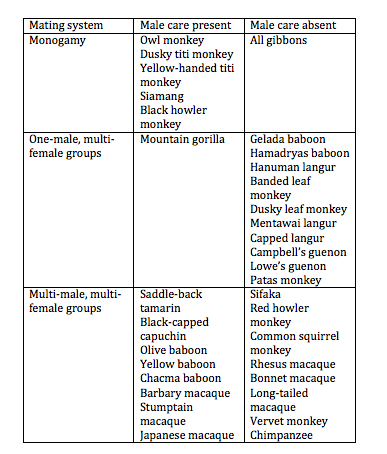
As you can see, there are quite a variety of ways in which primate families are structured. This is also true for humans, where cultural practices and personal choice play a significant role alongside environmental demands and biology in influencing marriage patterns and the ways in which males and females care for children.
So, Mr. Erickson, when it comes to the natural world, one can’t find easy justification for your essentialism. You cannot just claim the mantle of scientific authority without earning it honestly through a minimum of research to make sure your assertions are factual. Do better next time, or you’ll simply embarrass yourself further.
———————————————————————————————————–
References:
Gross. MR. 2005. The evolution of parental care. The Quarterly Review of Biology 80(1): 37-46 (http://academic.reed.edu/biology/courses/BIO342/2012_syllabus/2012_readings/Gross_2005.pdf)
Geary, D. C. (2005). Evolution of paternal investment. In D. M. Buss (Ed.), The evolutionary psychology handbook (pp. 483-505). Hoboken, NJ: John Wiley & Sons
Smiseth PT., Kölliker M, and Royle NJ. 2012. What is parental care? In The Evolution of Parental Care, First Edition. Oxford Univerity press
Zeh and Smith 1985. Paternal Investment by Terrestrial Arthropods. Integrative and Comparative Biology 25 (3): 785-805 (http://icb.oxfordjournals.org/content/25/3/785.short)
Dare mighty things!
Soyuz, carrying three members of Expedition 36 (Fyodor Yurchikhin, Karen Nyberg, and Luca Parmitano) has just docked with the International Space Station a few minutes ago (9:10 pm Central Time).
Here is what the docking sounds like.*
Congratulations to all the scientists and engineers who make this happen. Good luck on your mission!
—————————————————–
*from a previous docking, as recorded by Chris Hadfield
Edited to add:
Here is the quote by Theodore Roosevelt that the title references:
It is not the critic who counts; nor the one who points out how the strong person stumbled, or where the doer of a deed could have done better.
The credit belongs to the person who is actually in the arena; whose face is marred by dust and sweat and blood, who strives valiantly; who errs and comes short again and again, because there is no effort without error and shortcoming; who does actually strive to do deeds; who knows the great enthusiasms, the great devotion, spends oneself in a worthy cause; who at the best knows in the end the triumph of high achievement; and who at worst, if he or she fails, at least fails while daring greatly.
Far better it is to dare mighty things, to win glorious triumphs even though checkered by failure, than to rank with those timid spirits who neither enjoy nor suffer much because they live in the gray twilight that knows neither victory nor defeat.
 Violent metaphors