Erick Erickson has not earned the scientific authority he claims.

There’s been a lot of discussion in the news over the past few days regarding the recent report that four out of ten households with children in the United States are now headed by a “female breadwinner.”

This has cultural and economic implications that make for a lively political debate. And while I’m enjoying it in all its glory, there’s one particular aspect I want to respond to here. Specifically, these comments by pundit Erick Erickson:

I’m so used to liberals telling conservatives that they’re anti-science. But liberals who defend this and say it is not a bad thing are very anti-science. When you look at biology, when you look at the natural world, the roles of a male and a female in society and in other animals, the male typically is the dominant role. The female, it’s not antithesis, or it’s not competing, it’s a complimentary role.

He then doubled down on his position in a subsequent blog post responding to the critical backlash he received:

I also noted that the left, which tells us all the time we’re just another animal in the animal kingdom, is rather anti-science when it comes to this. In many, many animal species, the male and female of the species play complementary roles, with the male dominant in strength and protection and the female dominant in nurture. It’s the female who tames the male beast. One notable exception is the lion, where the male lion looks flashy but behaves mostly like a lazy beta-male MSNBC producer

By invoking science to justify his ideology, Mr. Erickson opens all his statements up to factual scrutiny.

There have been some really wonderful critiques of Mr. Erickson’s position, including this one by Amanda Marcotte, and Megyn Kelly’s interview here:

(One particularly memorable quote: “And who died and made you scientist-in-chief?” )

Indeed. Also inconveniently for Mr. Erickson’s position, not all animals structure their family roles in the same way as a traditional American household from the 1950s. [References for the information I present here are listed at the bottom of the page.]

What he’s clumsily referring to is something known as parental investment, and it’s a phenomenon which has been very extensively studied by ecologists and evolutionary biologists. Parental investment refers to the amount and kind of energy an organism devotes to its offspring in order to improve their survival chances. Parental investment takes many different forms, including pregnancy, territory defense, nest or bower building, grooming, protection, and food provision (or production, in the case of lactation). There are a great many potential trade-offs to this behavior, including energy expenditure, possible sacrifice of other mating opportunities, and potential exposure to predators in order to ensure offspring have better outcomes.

Among animal species, there exists both uni-parental care (one parent solely provides for the offspring) and bi-parental care (both parents contribute). The production of eggs tends to demand a greater expenditure of resources than the production of sperm, and usually in species with internal fertilization (the female carries the embryo to term), the female parent is heavily invested in each pregnancy and subsequent care of the offspring. It’s the extent to which the male is involved that is most variable. So already we see that Mr. Erickson’s partitioning of males and females in the natural world into “providers” and “nurturers” is incorrect: the female nearly always does the bulk of both “nurturing” and “providing” (and “protecting”, for that matter). There are some exceptions: Males do provision the offspring exclusively in a number of organisms, including many types of fish and bugs, but not in mammalian species. Bi-parental care can be found in a number of other organisms (including coyotes, marmosets, some bugs, and some birds).

But what about our closest relatives, primates? Surely if we were to draw lessons from the natural world about how to structure human families in a “natural” way, it would be from them!

This table compares the behavior of different primate species with their mating strategies (monogamy, single males with multiple females, and multi-male, multi-female groups). Here male care is broadly defined to include behaviors such as carrying, provisioning, grooming, and protection
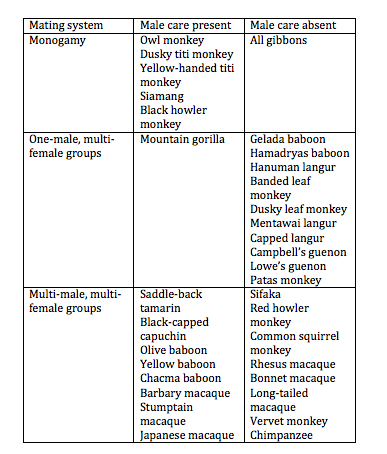
(From Smuts, Barbara B,  and Gubernick David J Male-infant relations in non-human primates, Table 1 p4. In “Father-child Relations: Cultural and Biosocial Contexts“, edited by Barry S. Hewlett. Transaction Publishers, 1992)
(From Smuts, Barbara B, and Gubernick David J Male-infant relations in non-human primates, Table 1 p4. In “Father-child Relations: Cultural and Biosocial Contexts“, edited by Barry S. Hewlett. Transaction Publishers, 1992)

As you can see, there are quite a variety of ways in which primate families are structured. This is also true for humans, where cultural practices and personal choice play a significant role alongside environmental demands and biology in influencing marriage patterns and the ways in which males and females care for children.

So, Mr. Erickson, when it comes to the natural world, one can’t find easy justification for your essentialism. You cannot just claim the mantle of scientific authority without earning it honestly through a minimum of research to make sure your assertions are factual. Do better next time, or you’ll simply embarrass yourself further.

———————————————————————————————————–

References:

Gross. MR. 2005. The evolution of parental care. The Quarterly Review of Biology 80(1): 37-46 (http://academic.reed.edu/biology/courses/BIO342/2012_syllabus/2012_readings/Gross_2005.pdf)

Geary, D. C. (2005). Evolution of paternal investment. In D. M. Buss (Ed.), The evolutionary psychology handbook (pp. 483-505). Hoboken, NJ: John Wiley & Sons

Smiseth PT., Kölliker M, and Royle NJ. 2012. What is parental care? In The Evolution of Parental Care, First Edition. Oxford Univerity press

Zeh and Smith 1985. Paternal Investment by Terrestrial Arthropods. Integrative and Comparative Biology 25 (3): 785-805 (http://icb.oxfordjournals.org/content/25/3/785.short)

Weekend ephemera

I know it’s technically no longer the weekend, but since it’s a holiday here in the United States, I’m going to ignore that fact. Here are some things I found interesting this past week:

Something I read:
“Going Clear: Scientology, Hollywood, and the Prison of Belief” by Lawrence Wright. I’ve been reading this a chapter at a time on the El while commuting to my lab, and I’ve finally finished it. It’s an absolutely fascinating glimpse into the inner workings of Scientology, coupled with a history of L. Ron Hubbard and how he came to found the organization.

Coincidentally, a few weeks ago on a date** I actually went to a Scientology-sponsored “Citizen’s Commission on Human Rights” traveling exhibit in Bucktown called “Psychiatry: An Industry of Death”. Essentially, the exhibit consists of a series of movies (which were boring and I skipped), and posters with super scary images:
Scary scientology psychiatry photo
with explanations in text about how psychiatry is a global conspiracy with a mission to generate profits and control the world by making up diseases and using torture treatments to subjugate people. Evidently psychiatry is the true cause of all the past evil in the world, responsible for the Holocaust, torture, apartheid, scientific racism, Russian gulags, and Hemingway’s death.

The exhibits were utterly fascinating, and all entirely wrong. I’m not going to go into a detailed refutation of their inaccurate claims here (although I could do that in another post if anyone’s interested). But I do want to encourage people to read a bit about the history and philosophy of Scientology, because efforts like these do have consequences. Not only do they misrepresent a medical profession and ongoing scientific research associated with it, they also further stigmatize mental illness and potentially increase the reluctance of people afflicted with such illnesses to seek treatment for themselves. While there are certainly worthy and interesting discussions to be had about the use of psychiatric medication, I urge you to educate yourselves and recognize the difference between legitimate critiques and blatant manipulation.

On a (much) lighter note…

Here are some things I found interesting on the web:

–This wind map of the United States is completely hypnotic . Definitely recommend staring at this for a while if you get stressed. Our planet is astonishing.

A blog post about how my sister, Julie Kedzie, poses a significant challenge to current UFC champion, Ronda Rousey. Obviously I agree!

–And finally, this stunning color film of London in 1927 gave me chills. I love glimpses into the past like this.

Do you notice how slowly vehicles moved? Life was at a different pace back then.

What do you think about Scientology? Am I now a Suppressive Person for speaking out about it? What did you like best about the London film? Do you have any book recommendations for me? I’d love to hear your thoughts in the comments below. And have a lovely and adventurous week, everyone!


For Americans, today is Memorial Day, a holiday to honor soldiers killed in wars. If you’re looking for a way to make a charitable gesture in this spirit, consider donating to the Wounded Warrior project to help injured veterans find financial assistance and employment opportunities.

————————————————————————————————-

**Yes, I go on incredibly weird dates.

On astrology

From my visit to the Very Large Array at the National Radio Astronomy Observatory (http://www.vla.nrao.edu/) last year. One of the most amazing places I've ever been.
From my visit to the Very Large Array at the National Radio Astronomy Observatory (http://www.vla.nrao.edu/) last year. One of the most amazing places I’ve ever been.

I was reading an insipid article this morning, and became curious as to how many people actually find astrology meaningful. The easiest metric at 7 am on a Saturday morning is (naturally) Twitter, so I checked out the account of an astrology author, Terry Nazon: 73,266 followers.
Ms. Nazon seems to be trying to emphasize the importance of astrology in our culture through the most recent tweet of hers:

“There are about 10,000 professional astrologers in America & only 3,000 professional astronomers”

I don’t know if that’s true or not (Ms. Nazon didn’t cite her source, so I’m skeptical), but her popularity and that of astrology in general is something that ought to make me depressed. But it doesn’t at all, and I’ll explain why at the end of the post.
Continue reading

What’s the difference between science and pseudo-science?

Science is a systematic method of acquiring information. It depends on the idea that the natural world works according to certain principles, and that we can discover those principles through observation and experimentation. Science isn’t the the only way of knowing about the world, but we give it special respect because it works so well. (I talked more about that in my previous post).

Sometimes unscientific belief systems masquerade as science in order to claim the benefit of that special respect. In many cases (magic, ghosts, the Loch Ness monster), it’s fairly easy to tell them apart. But what about homeopathy? Intelligent design? Energy healing? Schools don’t do a very good job teaching students to recognize and understand good scientific research. Fortunately it’s really not that difficult, but it DOES take one or two more steps beyond just accepting what you read.
Continue reading

A simple guide to how science works.

“If it disagrees with experiment it’s wrong.
In that simple statement is the key to science. It doesn’t make a difference how beautiful your guess is. It doesn’t matter how smart you are, who made the guess, or what his name is;
If it disagrees with experiment, it’s wrong”
–Richard Feyman

Here’s what it’s like to be a scientist:

You fall in love with a subject. You immerse yourself in your chosen subject, spending a few years reading all of the research that has ever been done in it. You go to conferences where you hear about what other people in your field have been doing, and you talk to them about what you’re doing. You share ideas.

You begin to observe some patterns, develop some ideas of your own about how your subject works. Questions about your subject that have never been answered occur to you. You think hard about whether they’re good questions, and ask advice from more experienced people in your field. You come up with testable ideas (called hypotheses), figure out experiments to test them, and what kind of data you need to in order to prove if they’re wrong.

Then you do the experiments. You think hard about the results you get. You repeat the experiments if you can. You do other experiments to see if you can disprove the results from the first experiments. You take your work to a conference and see what other experts think about it. Based on their feedback, you decide to publish your results and how you interpret them. You write up the whole process: questions, hypotheses, experimental design, results, and your interpretations of the results. You send it to a journal in your field.

The journal editor decides whether the paper is appropriate for the journal, and then contacts experts who specialize in the same field. These experts anonymously review the paper, decide whether the study is well designed, the results are valid, and the interpretation of the results is reasonable. If they decide that it’s acceptable, the paper is published. If not, the paper is rejected.

If your paper is published, your data are available to the rest of the scientific community. They may do the same experiments as you did, trying to replicate your findings. If they can’t replicate your data, or find problems with your interpretation, new ideas may take the place of yours. If they are able replicate your results and they stand the test of time, they may be used as a starting point for a new level of questions.

This basic process, repeated in thousands of laboratories around the world for a thousand years, is what lies behind the simplified form of the scientific method which you learned in school as:

Observation → Hypothesis→ Prediction → Experiment → Analysis →Interpretation →Publication → Replication

But in practice, it’s really more dynamic, like this:

Screen Shot 2013-05-05 at 11.11.37 AM

Here is a much more detailed (and very useful) description of how research is done.

Working in science requires that you are comfortable with uncertainty and doubt. Because the process of science is about disproving things, your own hypotheses can be disproven at any time. But this is why the scientific method is so powerful: it’s a type of inquiry that builds upon itself while being self-critical at the same time. It’s not perfect by any means, but it is, most importantly, effective. It works.

This is not to say that other ways of knowing about things (religiously, traditionally, intuitively) are wrong in themselves. But by definition they are not effective or useful for knowing things about the natural world, which operates according to physical principles. It’s fine if a person has other sources of knowledge, but it’s not fine to take advantage of the respect accorded to scientific knowledge and mislead people by trying to pass off non-scientific ideas as scientific. Fortunately, it’s fairly easy to recognize when this is happening if you know what to look for. I’ll write about this in my next post.