If you read my post on Kathy Miller’s recent talk at the Answers in Science event, you’ll recall that the Texas Board of Education is currently reviewing science textbooks for statewide adoption. This is a very important process, as historically creationists have attempted to insert their stupid arguments against evolution into school educational standards and textbooks. Since Texas is the largest buyer of textbooks in the United States, it has a huge influence on what publishers will produce.
Continue reading
Science
Mammals, fossils, and a paleontological FIGHT
I’m going to let you in on a little secret. Once in a while when you see “X revolutionizes our understanding of Y” in the science section of the news, it can be a teensy bit overstated.
This isn’t one of those times.
Continue reading
Creationism and Answers in Science: One weekend in Texas (with fossil porn!)

This past week, Houston hosted several major players in both the anti- and pro- evolution camps. The Texas Home School coalition had their annual convention on Aug 1-3, and unfortunately chose to invite Ken Ham as a keynote speaker. Ham has a long history of anti-science, anti-evolution advocacy, including recently criticizing Bill Gates’ “Big History” curriculum for teaching evolution.
In response to Ham’s presence at the convention, several groups, including Houston Atheists, Humanists of Houston and Houston Oasis, organized an “Answers in Science” educational event at the Houston Museum of Natural History.
Continue reading
GMO study is pseudoscience
I abhor the exploitative practices of Monsanto and companies like it. But truth is more important than politics, and I am always going to speak out when I see false information being touted as “science” to further an agenda.
I wanted to make this clear because I seem be writing a lot about the misrepresentation of GMOs as being harmful to your health. This article (“GMO feed turns pig stomachs to mush”) is by Natural News, which is emphatically NOT a scientific publication. It’s a site with a definite bias, and implies that people who disagree (I guess that means me?) are “paid online trolls, on-the-take ‘scientists.'”*
Natural News is a complete goofball pseudoscience website, but could the study they cite (Carman et al. 2013: “A long-term toxicology study on pigs fed a combined genetically modified (GM) soy and GM maize diet.”) be the first legitimate evidence that GMOs are harmful to health?
Continue reading
Cutting edge science
I’m attending my first Society for Molecular Biology and Evolution conference this week, and learning about some terrific research that my colleagues are doing. I just thought I’d share a few of the really neat things I’ve learned today.
Continue reading
What exercise does for your brain
My friends are extraordinary people. The people I’m attracted to are very driven and highly intelligent (and perhaps more than a little neurotic). The majority of them are also passionate about exercise.
“Exercise” is maybe too mild a term for this group: they are athletes devoted to a sport (either professionally or as committed amateurs), or they are coaches who are as relentless about training themselves as they are their students. To a person, they freely admit that this activity is essential for their mental well-being.
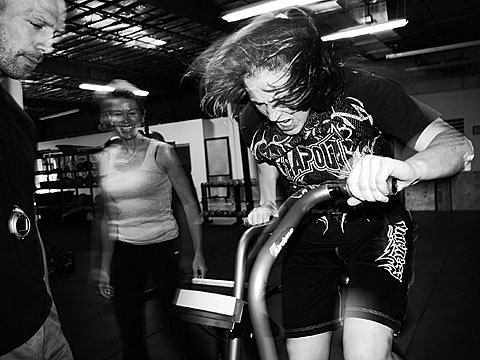
And while I believe that their lives are very stressful, they handle stress remarkably well. They seem to be very resilient when bad stuff happens to them. This is an anecdotal observation on my part, but it interested me enough to go read about the effects of exercise on the brain. Here’s what I found:
Continue reading
Wednesday morning bats!
Over the last few weeks, I’ve been in the midst of transitioning into my new position as a Research Fellow in the Anthropology Department at the University of Texas. As part of this process, I took a quick trip to Austin on Monday, and was happily surprised to find that a dear friend happened to be in town exactly when I was. He suggested that we go check out one of Austin’s most famous attractions: the Congress Avenue Bridge bats.
Continue reading
Scary chemicals in your food: A recent high-profile example of scientific illiteracy
I want to acknowledge a magnificent takedown of a terrible pseudo-scientific article.
Have you seen this BuzzFeed post on your Facebook timeline recently?
“8 Foods We Eat In The US That Are Banned In Other Countries”, written by Ashley Perez summarizes some claims made in “Rich Food, Poor Food”, a book by Dr. Jayson Calton and Mira Calton. It’s intended to give us the ‘real truth’ about the horrible chemicals that we’re ingesting on a daily basis. The problem? It’s complete nonsense to anyone who knows even a little bit about chemistry.
Continue reading
More on vaccines
I wanted to follow up my recent post on why you should vaccinate your children with a few recent pieces of news that I think are really interesting.
First, a study published this month in The Journal of Infectious Diseases reports that the HPV vaccine has been a resounding success. Since it became available in 2006, the vaccine has lowered the rate of HPV infection among teenaged girls by 56%. This is wonderful news, and I hope it encourages more people to get this vaccine.
It seems that one main point (no pun intended!) that anti-vaxxers raise in objection to the use of vaccines is the delivery system: injections. Do you think they would be so opposed if needles weren’t involved? Someday in the not too distant future there may be an alternative. Delivery of vaccine by nanopatches on the skin, as proposed by Professor Mark Kendall at the TedGlobal conference in Edinburgh, would not only be a lot less scary and invasive-seeming than needles, it would also significantly lower the costs of each vaccine. Nanopatches are still a long way from being complete, but I think they’re a terrific idea. You can read more about it here.
Finally, I’m going to be appearing on the One Guy Talking Podcast (http://www.talkshoe.com/talkshoe/web/talkCast.jsp?masterId=122865&cmd=tc)
with Ethan Sincoff tomorrow (Thursday) at 8pm EST. I believe that we’re going to be discussing all things science, including my own research. Tune in if you can, or download later if you can’t!
Why you should vaccinate your children
Andrew Wakefield’s fraudulent report that the MMR vaccine causes autism has resulted in a generation of children (~age 10-16) who have a historically low vaccination rate (below 50% in some places). As a result, the rate of measles infection has skyrocketed in Britain:

There have also been outbreaks in the United States, with significant infections so far this year in many places, including Brooklyn and New Jersey.
The good news is that thanks to excellent public health outreach in England, vaccination rates are improving significantly. But I worry that many people still don’t understand the issues. Let me summarize them for you:
Continue reading
 Violent metaphors