The truth about vaccinations: Your physician knows more than the University of Google

“A cousin of my mom’s survived Polio and lived the rest of his life with its effects. He was not expected to live past his teens but made it to his 40s. I am grateful that modern science can protect us from Polio and other diseases and I choose to take advantage of modern science to give my kid better odds of not dying from a preventable disease. I had heard a lot of noise from people claiming vaccines caused Autism, but never saw any clear evidence. It just seemed to me like people really wanted to point to something as the cause and they latched onto vaccines.”–Jennifer

I have been getting into a lot of discussions about whether vaccines are safe in the last few days. I’m not sure if it’s because of a post going viral about a (terrible) Italian court ruling last year (In contrast, American courts side with doctors and scientists on vaccine safety) or Jenny McCarthy’s recent hiring as co-host on “The View”, or simply (as a friend suggested to me today) the fact that a new school year is starting soon and parents are having to provide vaccination records to schools.

“(I got my children vaccinated) because the science supports it and I don’t want my kids to die. And civic reasons. It’s so straightforward.”–Britta

Whatever the reason, this week I’ve been in many conversations with individuals staunchly against vaccinations, parents who are very upset at the idea of unvaccinated children putting their own kids at risk, and parents who are confused and worried and want to know how to make the best decision possible for their children’s safety. I’m writing this for the third group of parents.
Continue reading

Creationism in Texas: good news!

If you read my post on Kathy Miller’s recent talk at the Answers in Science event, you’ll recall that the Texas Board of Education is currently reviewing science textbooks for statewide adoption. This is a very important process, as historically creationists have attempted to insert their stupid arguments against evolution into school educational standards and textbooks. Since Texas is the largest buyer of textbooks in the United States, it has a huge influence on what publishers will produce.
Continue reading

Creationism and Answers in Science: One weekend in Texas (with fossil porn!)

ammonite
This past week, Houston hosted several major players in both the anti- and pro- evolution camps. The Texas Home School coalition had their annual convention on Aug 1-3, and unfortunately chose to invite Ken Ham as a keynote speaker. Ham has a long history of anti-science, anti-evolution advocacy, including recently criticizing Bill Gates’ “Big History” curriculum for teaching evolution.

In response to Ham’s presence at the convention, several groups, including Houston Atheists, Humanists of Houston and Houston Oasis, organized an “Answers in Science” educational event at the Houston Museum of Natural History.
Continue reading

GMO study is pseudoscience

I abhor the exploitative practices of Monsanto and companies like it. But truth is more important than politics, and I am always going to speak out when I see false information being touted as “science” to further an agenda.

I wanted to make this clear because I seem be writing a lot about the misrepresentation of GMOs as being harmful to your health. This article (“GMO feed turns pig stomachs to mush”) is by Natural News, which is emphatically NOT a scientific publication. It’s a site with a definite bias, and implies that people who disagree (I guess that means me?) are “paid online trolls, on-the-take ‘scientists.'”*

Natural News is a complete goofball pseudoscience website, but could the study they cite (Carman et al. 2013: “A long-term toxicology study on pigs fed a combined genetically modified (GM) soy and GM maize diet.”) be the first legitimate evidence that GMOs are harmful to health?
Continue reading

What exercise does for your brain

My friends are extraordinary people. The people I’m attracted to are very driven and highly intelligent (and perhaps more than a little neurotic). The majority of them are also passionate about exercise.

“Exercise” is maybe too mild a term for this group: they are athletes devoted to a sport (either professionally or as committed amateurs), or they are coaches who are as relentless about training themselves as they are their students. To a person, they freely admit that this activity is essential for their mental well-being.

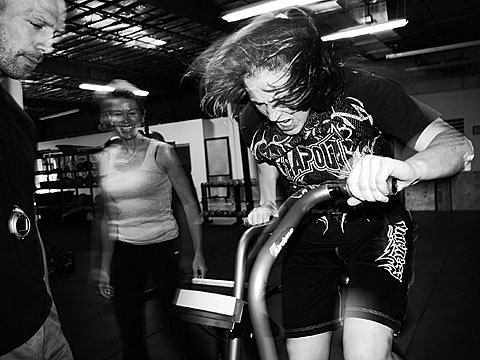
Cognitive therapy. Photo taken by gymjones.com
My own cognitive therapy. Photo taken by gymjones.com

And while I believe that their lives are very stressful, they handle stress remarkably well. They seem to be very resilient when bad stuff happens to them. This is an anecdotal observation on my part, but it interested me enough to go read about the effects of exercise on the brain. Here’s what I found:
Continue reading

Wednesday morning bats!

Over the last few weeks, I’ve been in the midst of transitioning into my new position as a Research Fellow in the Anthropology Department at the University of Texas. As part of this process, I took a quick trip to Austin on Monday, and was happily surprised to find that a dear friend happened to be in town exactly when I was. He suggested that we go check out one of Austin’s most famous attractions: the Congress Avenue Bridge bats.
Continue reading

Scary chemicals in your food: A recent high-profile example of scientific illiteracy

I want to acknowledge a magnificent takedown of a terrible pseudo-scientific article.

Have you seen this BuzzFeed post on your Facebook timeline recently?

“8 Foods We Eat In The US That Are Banned In Other Countries”, written by Ashley Perez summarizes some claims made in “Rich Food, Poor Food”, a book by Dr. Jayson Calton and Mira Calton. It’s intended to give us the ‘real truth’ about the horrible chemicals that we’re ingesting on a daily basis. The problem? It’s complete nonsense to anyone who knows even a little bit about chemistry.
Continue reading

More on vaccines

I wanted to follow up my recent post on why you should vaccinate your children with a few recent pieces of news that I think are really interesting.

First, a study published this month in The Journal of Infectious Diseases reports that the HPV vaccine has been a resounding success. Since it became available in 2006, the vaccine has lowered the rate of HPV infection among teenaged girls by 56%. This is wonderful news, and I hope it encourages more people to get this vaccine.

It seems that one main point (no pun intended!) that anti-vaxxers raise in objection to the use of vaccines is the delivery system: injections. Do you think they would be so opposed if needles weren’t involved? Someday in the not too distant future there may be an alternative. Delivery of vaccine by nanopatches on the skin, as proposed by Professor Mark Kendall at the TedGlobal conference in Edinburgh, would not only be a lot less scary and invasive-seeming than needles, it would also significantly lower the costs of each vaccine. Nanopatches are still a long way from being complete, but I think they’re a terrific idea. You can read more about it here.

Finally, I’m going to be appearing on the One Guy Talking Podcast (http://www.talkshoe.com/talkshoe/web/talkCast.jsp?masterId=122865&cmd=tc)
with Ethan Sincoff tomorrow (Thursday) at 8pm EST. I believe that we’re going to be discussing all things science, including my own research. Tune in if you can, or download later if you can’t!