This week Mike Adams, the self-styled “Health Ranger”, who runs the alternative medicine website Natural News, posted one of the most disturbing tirades against scientists that I’ve ever seen. He’s always been a promoter of pseudoscientific arguments against GMOs, but he has gone much, much further in his latest piece “Biotech genocide, Monsanto collaborators and the Nazi legacy of ‘science’ as justification for murder” (WARNING: Graphic and disturbing imagery of Holocaust victims at the link). Continue reading
Month: July 2014
Come hear me speak in Dallas!
I’ve been invited by the awesome people in the North Texas Skeptics organization to come speak to them, so tomorrow (July 18th), I’ll be giving a talk on “Molecules and myths: What anthropological genetics tells us about the prehistory of the Americas”. Here’s the synopsis:
For hundreds of years, Europeans have been trying to insert themselves into Native American prehistory, developing elaborate explanations for how their monumental architecture, art, technology, and even genetic ancestry ought to be attributed to non-Indigenous peoples (whether human, alien, or Sasquatch). I will discuss some of the old and new pseudoscientific hypotheses pertaining to Native Americans, and how the field of anthropological genetics is rapidly demolishing these ideas. I’ll give a brief overview of how ancient DNA research is done, and discuss what is currently known about the genetic prehistory of Native Americans—and why this subject matters in our current political and social climate.
Here are the details of the event: http://www.meetup.com/North-Texas-Skeptics/events/188830672/
If you’re in the area, come out and say hi!
Sexual harassment and scientific fieldwork

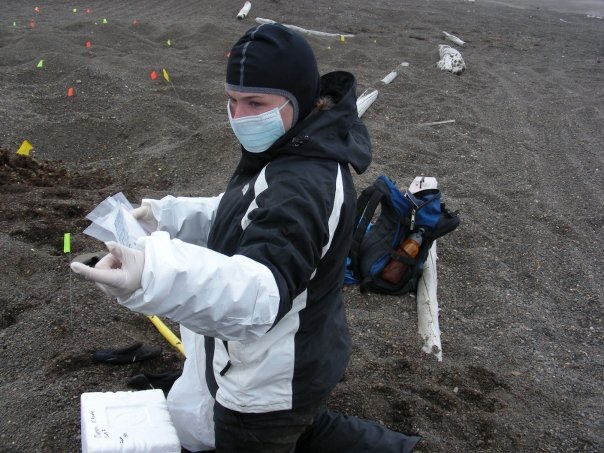
My friend and colleague, Julienne Rutherford, and her co-authors Kathryn Clancy, Robin Nelson, and Katie Hinde have just published a groundbreaking study on fieldwork experiences among women in science. Disturbingly (though unsurprisingly for those of us who have done fieldwork), a majority (72.4%) of respondents to their survey “reported that they had directly observed or been told about the occurrence of other field site researchers and/or colleagues making inappropriate or sexual remarks at their most recent or most notable field site.” Further, a majority (64%) reported that they had personally experienced sexual harassment. (It’s important to note that men also responded to this survey to report experiencing and/or witnessing harassment, although at a lower frequency than women.)
This is one of those rare cases where I don’t need to recap the findings of the article, because the authors have published it in an open-access journal (PLOS ONE), and so I encourage you to go read the study itself here, and the Science news report about it by Ann Gibbons here.
Fieldwork is an occasional, but very important part of my job, and from my experiences I can attest that junior people in the field, particularly students, are extremely vulnerable. I applaud these researchers for calling attention to this problem, and I hope that it will be the beginning of a very important conversation about how to make fieldwork safer for everyone.
*** UPDATE: This piece, by Andrew David Thaler, is a must-read. I’d been debating about whether to write about the Richard Feynman controversy going on in the last few days, but instead I’ll just recommend that you check out the links in the first paragraph, particularly to Matthew Francis’ post on the subject.
Yet more responses to scientific racism
In recent weeks, Nicholas Wade’s book A Troublesome Inheritance has been soundly criticized on the basis of his misunderstanding (or misrepresentation) of the statistical methods used to study human genetic variation (see Jeremy Yoder’s critique here, Chris Smith’s here, Joseph Graves’ here, and mine here ), his misunderstanding of evolution (see Michael Eisen’s critique here, and Eric Michael Johnson’s here ), and his misunderstanding of human biological variation (see Greg Laden’s critique here, Agustin Fuentes’ critique here, and Jon Marks’ here ). These criticisms–all from biologists and biological anthropologists– can be boiled down into a single statement: Mr. Wade’s book is scientifically unsound.
His responses thus far (to those of us who published in the Huffington Post) have failed to engage any of the substantive issues that have been raised. Instead, he dismissed our standing for discussing this issue, calling me a “postdoctoral student” (A science journalist should be aware that postdocs aren’t students), and dismissing Dr. Fuentes’ and Dr. Marks’ research background and credentials (as if biological anthropologists were not scientists). I have not seen any response yet to the numerous other critiques from biologists that have appeared elsewhere (many listed in the previous paragraph), which raise many of the same concerns.
Mr. Wade may feel that he can ignore the substantive critiques of his book by scientists. But can he do the same for fellow science journalists? David Dobbs’ review of Mr. Wade’s book appeared in the New York Times Book Review this past Sunday (the online version can be read here). It is not favorable. Mr. Dobbs calls the book “deeply flawed, deceptive, and dangerous.”
In discussing the study (critiqued by most of us above) that Mr. Wade claims supports the genetic basis for three (or is it five?) “continental races”, Mr. Dobbs notes that the paper itself
“directly contradicts Wade’s argument. Yet he baldly claims the study as support. And he does this sort of thing repeatedly: He constantly gathers up long shots, speculations and spurious claims, then declares they add up to substantiate his case. The result is a deeply flawed, deceptive and dangerous book.”
Mr. Dobbs elaborates on this in the companion piece on his blog:
“Wade demonstrates how a lucid, well-written, selective presentation of evidence — eloquent, elegant cherry-picking — can convince smart people of pernicious ideas that seem scientific, but which science does not support. Much of the sleight of hand in this book will not be evident to people who don’t know the field. In some cases one has to read a specific paper cited by Wade to recognize that he thoroughly misrepresents its findings.”
I encourage you to go read both of Mr. Dobbs’ critiques. It will be interesting to see how Mr. Wade responds.
**************************************
Update: Here are a few other critiques worth mentioning:
A Troublesome Ghost by Dr. John Edward Terrell
In addition to the post I cited above, Dr. Chris Smith also takes on Wade’s mischaracterization of
the genetic basis for violent behavior in different populations.
He also discusses in detail Wade’s repeated assertion that human evolution has been “recent, copious and regional”.
And if you’d like to listen to an interesting discussion on race, genetics, ancestry testing, and human biology, here’s an appearance by Agustin Fuentes on the Center for Environmental Health podcast.
Spot the pseudoscience: Cat food edition
Why a Federal Court Ruled Against Anti-Vaxers
Last month in the case of Phillips v. New York, a federal judge upheld a New York City policy barring unvaccinated children from schools where a vaccine-preventable illness has been diagnosed. The case received a lot of attention from the media, including the New York Times and Slate. But these articles don’t say much about what really happened in the case. Since the case dealt with the same kinds of arguments many anti-vax parents make, I went through it to acquaint myself with the law. Since I was reading up on it anyway it might be useful or interesting to other people to see how a case like that works. Bear in mind that this is a broad-strokes explanation, and I’m going to oversimplify some of the legal principles. But if you’re curious how the sausage is made, read on.